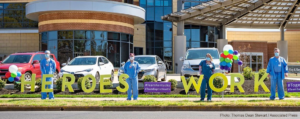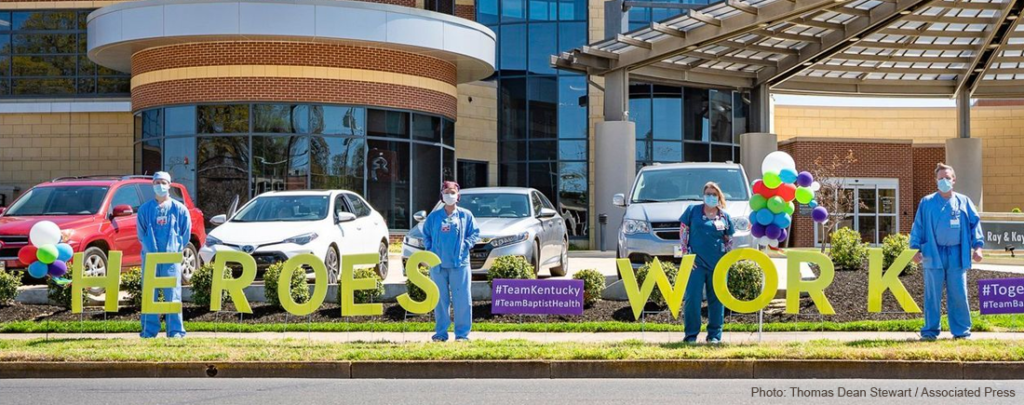
Staff at Baptist Health Paducah in Paducah, Ky., earlier this month. Baptist Health is using an AI-powered platform from remote-patient-monitoring startup Current Health to track about 20 Covid-19 patients.
Read the original article here
WSJ on AI for remote monitoring and Ninety One
Hospitals, working to conserve space for people with severe cases of Covid-19, are employing advanced forms of remote monitoring that make it easier to treat patients with milder symptoms in their homes.
The need to limit hospital admissions is urgent given that the number of U.S. coronavirus cases has soared above the half-million mark, stretching the resources of hospitals in places such as New York. Health-care providers also rely on home monitoring as a way to reduce the spread of the coronavirus.
Some hospitals are trying out new forms of monitoring technology based on artificial intelligence.
Using AI to keep track of Covid-19 patients is promising, according to Eric Topol, director of the Scripps Research Translational Institute. “We get distracted and we can’t process all that data,” Dr. Topol said. “This is a sweet spot for AI.”
Baptist Health, an eight-hospital system operating mostly in Kentucky, is using an AI-powered platform from remote-patient-monitoring startup Current Health Ltd. to track about 20 Covid-19 patients.
The 51-hospital Providence health system, based in Renton, Wash., has deployed remote monitoring to care for Covid-19 patients.
The LSU Healthcare Network in the New Orleans area this week plans to start using artificial intelligence to remotely monitor cardiac patients, believed to be highly vulnerable to coronavirus.
The Current Health system employed by Baptist Health has been used to monitor patients with other conditions, such as congestive heart failure. It includes a wearable device that is worn 24/7 to track vital signs. Patients are also given tablets that help monitor them.
Data from the wearable and the tablet is transmitted to Current Health. Its machine-learning technology establishes a baseline reading for each patient, which enables the system to spot anomalies such as a decrease in oxygen levels, said Christopher McCann, the company’s chief executive and co-founder.
Patient information is displayed on a dashboard and alerts are sent to a medical team if a patient’s condition appears to be deteriorating.
The system can help medical staff monitoring at-home Covid-19 patients deal with the unpredictability of the illness. Patients with the novel coronavirus can appear relatively fine one moment, then take a sudden turn for the worse.
“They’ve been different,” Brett Oliver, chief medical information officer at Baptist Health, said of Covid-19 patients. “They tend to crash quickly.”
When Baptist Health receives an alert, the staff can initiate a video chat or do a virtual assessment with the patient through the tablet. If a patient needs immediate medical care, the staff can dial 911.
The Providence health system is using tools from health-care technology company Twistle Inc. to monitor more than 1,000 confirmed and suspected Covid-19 patients in their homes.
Those individuals have been sent home with pulse oximeters—small devices worn on the finger that read blood oxygen levels—and thermometers. Patients receive a text message utilizing Twistle three times a day with a link to an online form they use to share their vitals and other information on how they are feeling. The data is sent to Twistle, which weights and analyzes the information.
Twistle has started developing a machine-learning version of its system and hopes to roll it out soon, said Kulmeet Singh, the company’s chief executive. It will help automate decisions such as who needs a pulse oximeter.
The LSU Healthcare Network this week plans to start using AI to remotely monitor high-risk cardiac patients at home to reduce their risk of exposure to the new coronavirus, said Frank Smart, a cardiologist at the health-care network in Louisiana, a hot spot for Covid-19.
Data from pacemakers, defibrillators and other devices is sent via wireless networks to each device’s manufacturer. The data from the manufacturers is pushed to a cloud service from Ninety One Holding Inc., which uses computer vision and machine learning to interpret patterns such as heart rhythm. Ninety One’s cloud service alerts a doctor if it detects anomalies.
Write to John McCormick at john.mccormick@wsj.com and Agam Shah at agam.shah@wsj.com